See how activities work
Turn what you learn into something you do.
An activity is the part of a guide that leaves the screen. You already have a method. The activity gives you one thing to try in your own life, and a place to write what happened.
Activities open after you have an action plan. That part of a guide needs a paid plan.
The task
You know what to do when it is time to practise
Each activity tells you the action, whether you do it alone or with someone else, and what to notice while you are in it.
Some activities are one small action. Start a conversation. Ask for feedback. Send one page. Others are a series of tasks over time, and you return for the next one.
Some you can do straight away. Others wait until the moment shows up: the meeting, the conversation, the message you were going to send.
What to expect: instructions written for a real attempt, not a quiz about the lesson.
The record
Come back and write what happened
After the attempt, you record it. That might be a short check, a few questions, or a worksheet made for that task.
Where the activity allows it, you can add a photo or a voice note. Write what you actually did, including what was difficult or unfinished. A tidy invention is not useful when you read the record later.
The record stays with your plan and your earlier answers. You can open it again from your dashboard.
What to expect: a saved account of the attempt. Paid, as part of the activity.
Examples
Activities look like a task, not a lesson
These are real activity pages. Each one names the action, shows a picture, and gives the instructions you follow.
You will not see every activity on the first day. The one you open is the one that fits the guide you are in, and the moment you chose.
Example
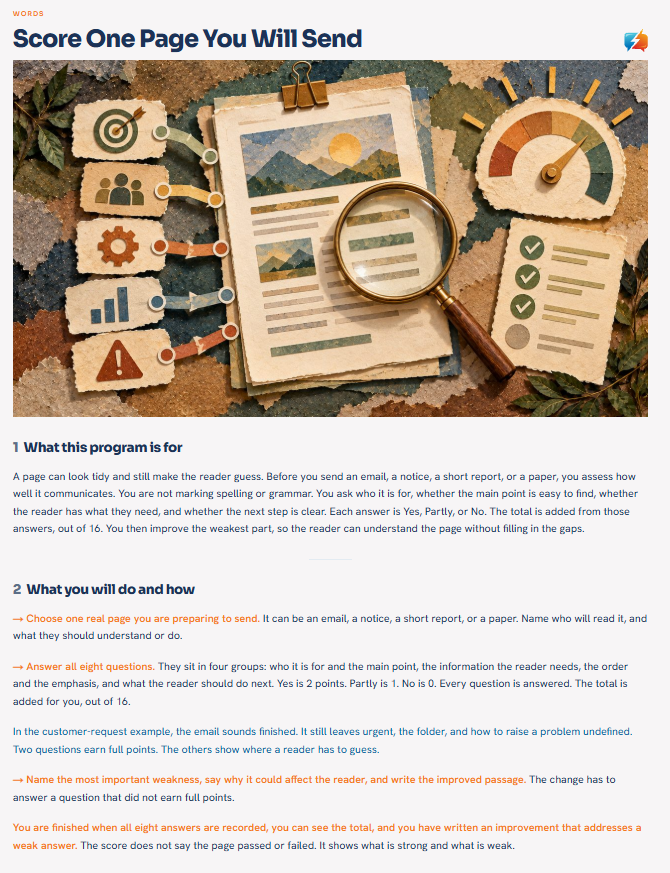
Score One Page You Will Send
One activity asks you to prepare a single page you will actually send. The page tells you what to include and what to do with it afterwards.
Example
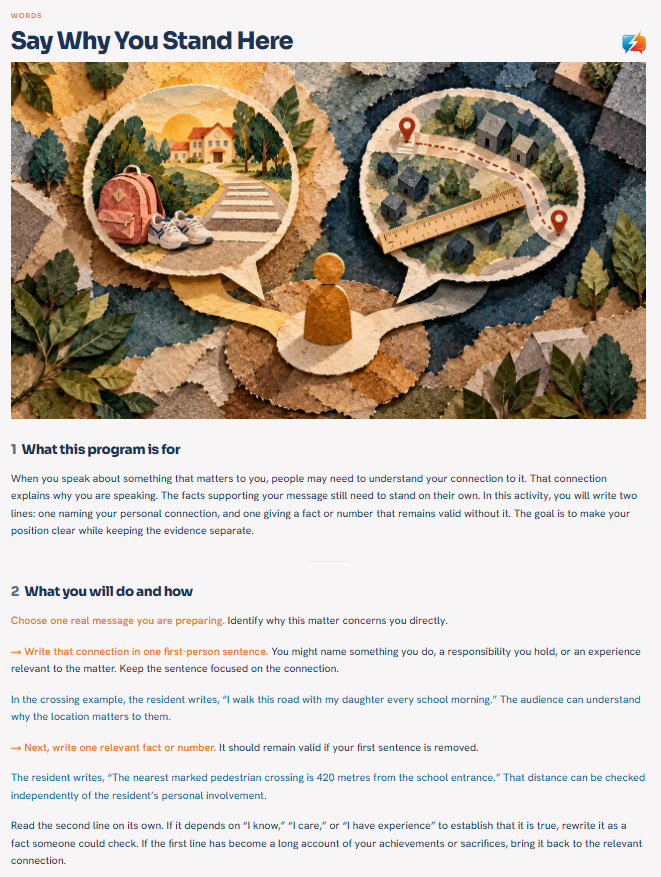
Say Why You Stand Here
Another asks you to say, in a real conversation, why you hold the position you hold. The instructions stay with that one moment.
Example
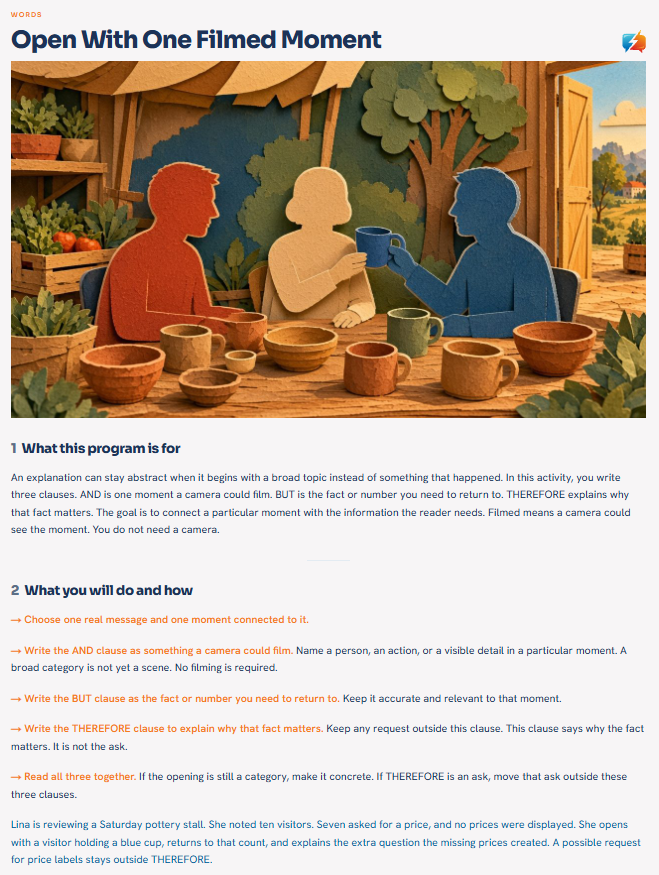
Open With One Filmed Moment
This one starts from a short filmed moment. You use that opening, then follow the steps the activity gives you.
Example
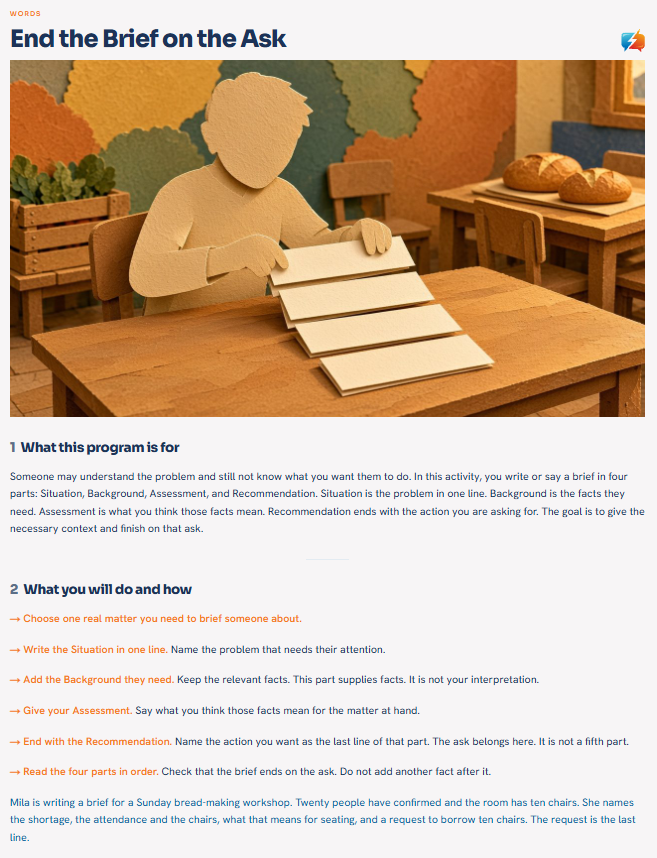
End the Brief on the Ask
This one is about how a brief ends: you close on the ask, not on a vague hope that the other person will guess it.